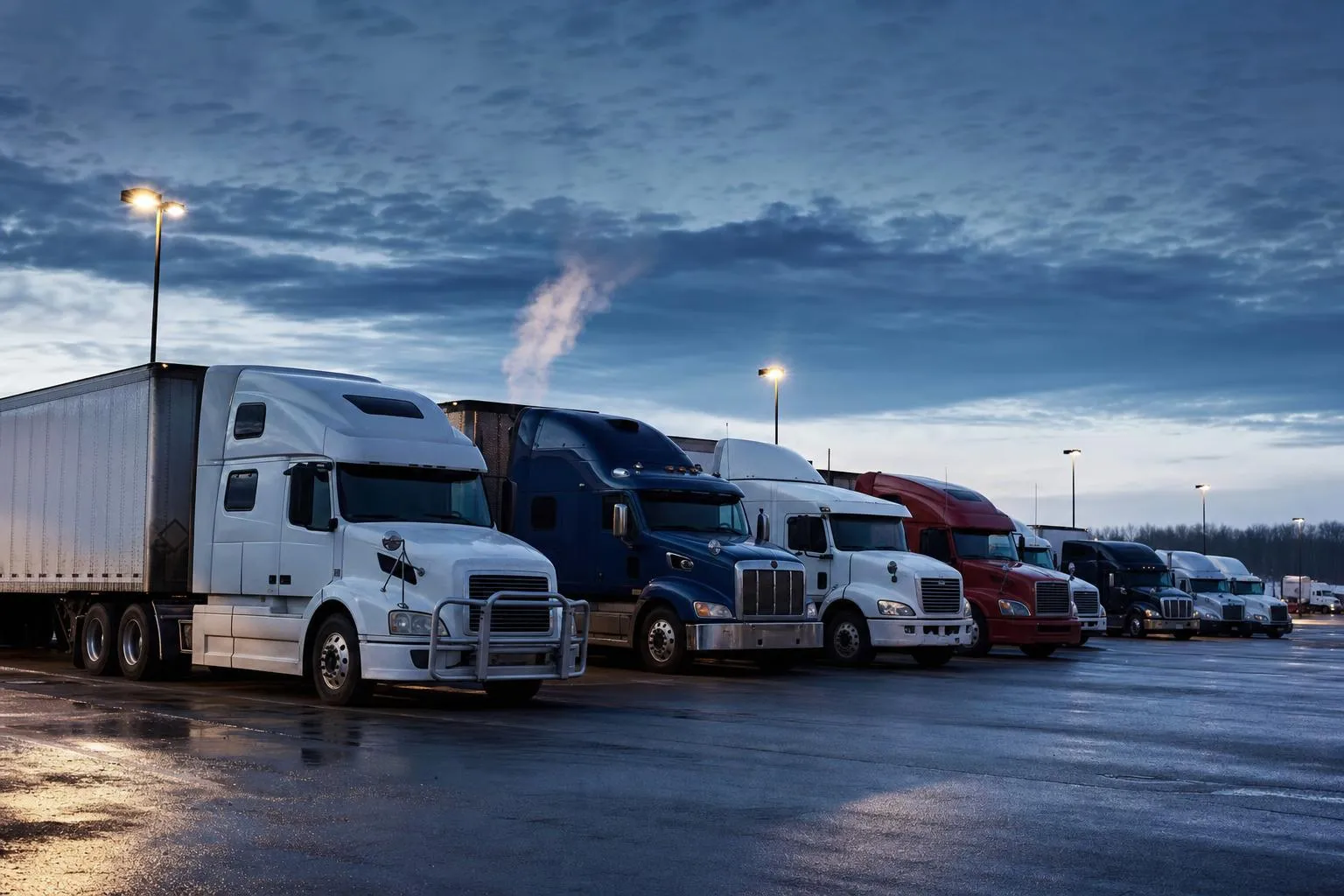
How a 14-truck fleet in Ohio cut idle time 38% in six months
A telematics swap, a per-truck idle bonus, and dispatch retraining. The full playbook, with the numbers.
Six months ago, Troy Benson’s 14-truck regional flatbed operation in Canton, Ohio was idling away roughly $4,200 a month in fuel — not counting the engine-hour wear that accelerates maintenance intervals. His telematics platform was logging it; he just wasn’t doing anything about it. By this spring, his idle time was down 38% and the monthly fuel savings were covering the lease on two new trailers.
This is what he changed, and the order he changed it.
The baseline: what the data actually showed
Benson’s previous system logged GPS position and basic engine data but didn’t break idle time out cleanly enough to act on. When he switched to a platform with configurable idle alerts and driver scorecards, the first report was sobering: average daily idle across the fleet was 2.4 hours per truck. At his fleet’s average fuel consumption and diesel at $3.89/gal, that came to roughly $10 of idle fuel per truck per day.
The distribution mattered more than the average. Two trucks — both driven by the same two drivers — accounted for 31% of all idle time. Three others were near the fleet average. The rest were significantly better. The problem was not the fleet; it was specific behavior that nobody had been tracking.
Change 1: Alerts that go to drivers, not just dispatch
The first change Benson made was enabling real-time idle alerts to drivers’ phones, not just to his dispatch dashboard. His telematics vendor’s default setup routed idle notifications to the fleet manager. He reconfigured it so that any continuous idle over 8 minutes triggered a push notification to the driver directly.
The effect was immediate and measurable. In the first two weeks, average idle dropped 14% with no other changes. Several drivers had no idea how much they were idling — the alert made the behavior visible for the first time.
Change 2: The per-truck idle bonus
Benson added a simple incentive structure: any driver who finished a month with daily average idle under 45 minutes earned a $75 bonus. Any driver under 30 minutes earned $125. The bonuses were posted on a weekly leaderboard shared with the whole fleet.
The leaderboard was the key variable, not the dollar amount. Several drivers said in the months that followed that they’d have competed for a $20 bonus. Being the high-idle driver on a visible board was enough motivation on its own.
At the end of the first full incentive month, 11 of 14 drivers qualified for the $75 bonus. Total bonus payout: $900. Estimated fuel savings from the idle reduction in that month alone: $1,100.
Change 3: Dispatch retraining on layover and pre-trip scheduling
The two high-idle drivers were outliers, but an audit of their routes revealed a structural problem: their assigned runs involved more dock wait time than average, which meant they idled longer for environmental control. Fixing this required changing dispatch practice, not just driver behavior.
Benson’s dispatcher began building 20-minute dock-arrival buffers into the schedule rather than optimizing purely for on-time tender. This gave drivers enough margin to shut down rather than keep the cab conditioned during a long dock wait. The two high-idle drivers’ numbers came down faster than anyone else’s once the schedule changed.
Month 6 results
- Average daily idle per truck: 1.49 hours (down from 2.4 hours, -38%)
- Monthly fleet fuel savings attributable to idle reduction: $1,500–$1,700 (varies with diesel price)
- Monthly bonus cost: $825–$975 (varies with driver performance)
- Net monthly savings: approximately $525–$875
- Engine-hour reduction: estimated 33% fewer idle engine hours, which pushes out oil change intervals on three trucks by 3,000–4,000 miles per year
The insurance carrier noticed, too. Benson’s commercial auto broker flagged the telematics score improvement at his November renewal meeting. The underwriter didn’t guarantee a rate reduction, but the improved safety and idle data were on record for the next renewal cycle.
What Benson would do differently
He would have enabled the driver alerts on day one rather than running the system in a reporting-only mode for six months first. “I was collecting six months of data that I wasn’t acting on. That’s real money I left on the table.”
The leaderboard was his other wish-I’d-started-sooner. Drivers, in his experience, are more motivated by visible standing relative to peers than by a dollar amount. The incentive program only worked as well as it did because the leaderboard made performance public within the team.
The telematics setup
Benson uses Motive (formerly KeepTruckin) for his primary fleet management platform, with dashcam integration enabled on 10 of 14 trucks. The idle-alert configuration is standard in Motive’s fleet-tier plan and does not require an add-on. His previous system — a white-label ELD from his original carrier setup — did not support configurable idle thresholds or driver-direct notifications.
The upgrade cost him $28/truck/month (on a 3-year contract) compared to $19/truck/month previously. The $126/month delta paid back in reduced fuel in the first month.